 If your content isn’t converting…
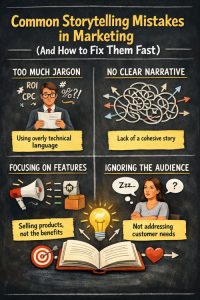
There’s a good chance you’re making one (or more) of these common storytelling mistakes in marketing.
Here’s the truth:
Most marketers don’t fail because of bad offers…
They fail because their stories don’t connect, engage, or convert.
In this guide, you’ll learn the biggest mistakes — and exactly how to fix them.
Why Storytelling Mistakes Kill Conversions
Storytelling isn’t just about being creative.
It’s about:
Guiding attention
Building emotion
Leading to action
When any of those are missing…
Your conversions drop.
If you want the full system behind high-converting storytelling, read:
Best AI Storytelling Tool for Marketing (That Actually Converts)
The Most Common Storytelling Mistakes in Marketing
❌ Mistake #1: Starting Without a Clear Hook
If your story doesn’t grab attention immediately…
People won’t keep reading.
Bad Example:
“Today I want to talk about marketing…”
Fix:
Start with a relatable pain point.
Better Example:
“I was creating content every day… but getting zero sales.”
❌ Mistake #2: Making the Story About You
Your audience doesn’t care about your story…
They care about THEIR problem.
Fix:
Position your story around:
Their struggles
Their frustrations
Their desired outcome
❌ Mistake #3: No Clear Structure
Random storytelling = random results.
Without structure:
Your message gets lost
Your story feels confusing
Your audience disengages
Learn how to structure stories properly:
How to Use AI for Storytelling in Marketing
❌ Mistake #4: No Emotional Connection
Facts don’t sell.
Emotion does.
If your story doesn’t include:
Pain
Frustration
Desire
…it won’t convert.
❌ Mistake #5: Weak or Missing Call to Action
This is the biggest conversion killer.
You told a great story…
But didn’t tell the reader what to do next.
If you want to fix this, read:
How to Write Sales Stories That Convert
❌ Mistake #6: Being Too Vague
Generic stories don’t connect.
Fix:
Use specific details:
Situations
Feelings
Outcomes
❌ Mistake #7: Forcing the Offer
If your pitch feels unnatural…
People will resist it.
Fix:
Let the story lead into the offer naturally.
See examples here:
AI Storytelling Examples for Marketing
Real Example: Bad vs. Good Storytelling
❌ Weak Story:
“This product is great and helps with marketing. You should try it.”
✅ Strong Story:
“I spent months trying to make my content work…
Posting every day, hoping something would click.
But nothing converted.
Then I realized I wasn’t telling stories that connected.
Once I fixed that, everything changed.”
The difference:
Emotion
Structure
Relatability
The Fastest Way to Fix Your Storytelling
You could try to fix everything manually…
Or use a tool that guides you step-by-step.
Start here:
Storytelling Sales Formulator AI
This helps you:
Avoid common mistakes
Follow proven storytelling frameworks
Create content that actually converts
Why Fixing These Mistakes Matters
When you eliminate these storytelling mistakes:
Your content becomes clearer
Your audience connects faster
Your conversions increase
That’s the difference between content that gets ignored…
…and content that drives results.
Ready to Improve Your Storytelling?
If you want to fix your storytelling and start seeing better results:
Click here to get started:
Storytelling Sales Formulator AI
FAQ: Common Storytelling Mistakes in Marketing
What is the most common storytelling mistake in marketing?
Starting without a strong hook. If you don’t grab attention immediately, your audience won’t continue reading.
Why don’t my stories convert?
Usually because they lack structure, emotion, or a clear call to action.
How do I make my stories more engaging?
Focus on relatable problems, emotional experiences, and clear outcomes.
Can AI help fix storytelling mistakes?
Yes. AI can guide structure, improve clarity, and help create more effective stories.
What should every marketing story include?
A problem, emotional struggle, turning point, solution, and a clear next step.