How to Start Affiliate Marketing for Beginners (Even If You Have No Experience or Money)
 Affiliate marketing sounds easy until you’re actually standing at the starting line.
You see people talking about commissions, passive income, and “just posting links.” Meanwhile, you’re staring at a blank screen wondering where beginners are supposed to begin—especially if you don’t have money, experience, or an audience.
Here’s the honest truth: affiliate marketing for beginners can work, but only when you understand what the game really is.
It’s not about tricking people into clicking links. It’s about placing helpful content in front of someone who’s already looking for an answer—and letting the product do the convincing.
Once you see affiliate marketing through that lens, everything simplifies.
This guide strips affiliate marketing for beginners down to what truly matters—especially if you’re starting from zero. No experience. No email list. No ad budget. Just a clear, realistic path that compounds over time.
Can You Really Start Affiliate Marketing With Nothing?
You don’t need capital to start. What you need is the willingness to build something that doesn’t pay immediately but compounds quietly over time.
That’s why most people quit early. And why beginners who don’t quit end up winning. When you start affiliate marketing with no experience, you’re not behind—you’re unconditioned.
You don’t have bad habits yet. You’re not chasing shortcuts that don’t work. You’re learning from the ground up.
Affiliate marketing for beginners has one unavoidable cost: time and focus. What you’re trading instead of money is learning speed, consistency, and patience.
Here’s what you don’t need to start:
-
A registered business
-
Paid ads
-
Fancy software
-
A huge audience
Here’s what you do need:
-
A platform (free or owned)
-
A niche people already spend money in
-
Content that solves real problems
-
Traffic that compounds instead of disappears
Affiliate marketing works because you’re not creating products. You’re inserting yourself into an existing demand stream—and guiding people to the right solution at the right moment.
Free Platforms Beginners Can Use (And Their Tradeoffs)
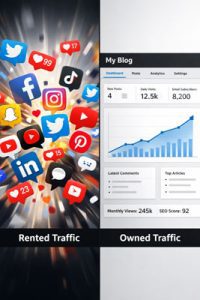
Free platforms make starting possible, but they also create a trap. Social media feels productive because numbers move fast. Views, likes, comments. But when you stop posting, everything vanishes.
A website doesn’t behave like that. A single article can work for you months or even years after you publish it. That’s why beginners who quietly build content assets end up overtaking louder creators who never slow down long enough to build foundations.
Blogs (Best Long-Term Option)
- Content can rank on Google for years
- Traffic compounds over time
- Full control over monetization
Downside: SEO takes patience.
YouTube
- Trust builds faster through video
- Strong buyer intent for reviews
- Discoverability is algorithm-dependent
Downside: Production effort and camera confidence.
TikTok / Instagram
- Fast reach
- No upfront cost
- Great for top-of-funnel awareness
Downside: Traffic disappears if you stop posting.
Beginner truth: Social platforms rent you traffic. A website lets you own it.
Many beginners start on social platforms while slowly building a blog in the background. This hybrid approach balances speed and stability.
Picking Your First Affiliate Offer (The Beginner-Safe Way)
Choosing an affiliate product isn’t about commission percentages—it’s about alignment. If the product solves a real problem you understand, your content writes itself. You don’t sound salesy because you’re explaining, not pitching.
Beginner-friendly offers usually have:
- Clear value (easy to explain)
- Existing demand
- Real reviews and proof
- Simple onboarding
Good places to start:
- Amazon Associates (low commissions, high trust)
- Digital products (higher payouts, better leverage)
- Software tools with recurring commissions
Avoid:
- Products you don’t understand
- Overhyped “miracle” offers
- Anything that requires aggressive selling
Your job isn’t to convince people to buy—it’s to help them decide.
Creating Content That Gets Clicks (Without Being Salesy)
 Affiliate content works best when it matches search intent.
Beginner-friendly content types include:
- “How to” guides
- Product comparisons
- Beginner walkthroughs
- Problem–solution articles
Instead of pushing links, structure content like this:
- Identify the problem
- Explain why it’s frustrating
- Walk through solutions
- Introduce the product naturally
- Share who it’s best for (and who it’s not)
This approach builds trust—and trust converts better than hype.
How Beginners Get Traffic Without Ads

Paid ads amplify systems. They don’t fix broken ones. Affiliate marketing for beginners, organic traffic is the safest starting point. Traffic follows usefulness.
Not hype. SEO rewards patience in a way almost nothing else online does. You answer real questions clearly, consistently, and honestly—and over time, search engines start sending people who are already halfway to buying.
SEO (Search Engine Optimization)
- Targets people already looking for solutions
- Traffic compounds over time
- Content works while you sleep
Start with long-tail keywords like:
- “best [tool] for beginners”
- “how to use [product] step by step”
- “is [product] worth it”
These searches come from people close to buying.
Content Consistency > Virality
One helpful article that ranks beats 50 posts that disappear.
Focus on usefulness, clarity, and depth. Google and humans reward content that actually helps.
Scaling From $0 to Consistent Income
 Affiliate marketing grows in layers.
First layer: learning and setup
Second layer: content and traffic
Third layer: optimization and scaling
Once content starts ranking or getting traction:
- Update old posts
- Add internal links
- Test better offers
- Build an email list
Over time, your content becomes a system—not a hustle.
That’s when affiliate marketing clicks. Income doesn’t arrive all at once. It trickles. Then steadies. Then surprises you and one day, content you forgot you wrote sends a commission notification you didn’t expect. That’s the quiet power beginners underestimate.
Affiliate marketing doesn’t pay beginners for enthusiasm. It pays them for structure, patience, and trust.
Products / Tools / Resources
- Beginner-friendly affiliate networks (Amazon Associates, Clickbank)
- Keyword research tools for low-competition ideas
- Website builders and hosting platforms
- AI tools for content outlining and optimization ( Results with Kevin AI )
- Email marketing tools for long-term scaling ( Aweber )